



A sales funnel is the path a customer takes from their first contact with your business to a purchase, split into stages where some people drop off.
Sales funnel stages
A sales funnel describes the path from someone's first contact with your business to a purchase. It is called a funnel because fewer people remain at each stage: many see the ad, some click, fewer leave their details, and fewer still buy.
In reports you will see the abbreviations TOFU, MOFU and BOFU: top, middle and bottom of the funnel.
- Awareness: someone sees your ad or video for the first time.
- Interest: they click, look at your website, read reviews.
- Decision: they leave their details, talk to a salesperson, get an offer.
- Purchase and return: they buy, leave a review, come back for another service.
The funnel in numbers
The funnel is easiest to understand with numbers. Example: 50,000 impressions, 1,000 clicks, 60 leads, 30 conversations, 10 sales. You can see right away where most people drop off. If you only reach 30 of your 60 leads by phone, the problem is not the ad but the follow-up after signup.
Each stage has its own metric: CTR for the ad, conversion rate for the page, answered-call rate and close rate for the sales team.
With a Meta instant form, the funnel is shorter, because there is no website in the middle. Inquiries come in faster, but the later stages matter even more: follow-up and the conversation.
How to plug the leaks in your funnel
You usually gain the most by fixing the weakest stage, not by adding budget to the top of the funnel.
- Remarketing to people who watched your video or visited your page but did not leave their details.
- An automatic text and email right after signup.
- A fast first call, before the customer asks a competitor.
- Appointment reminders, to cut down on no-shows.
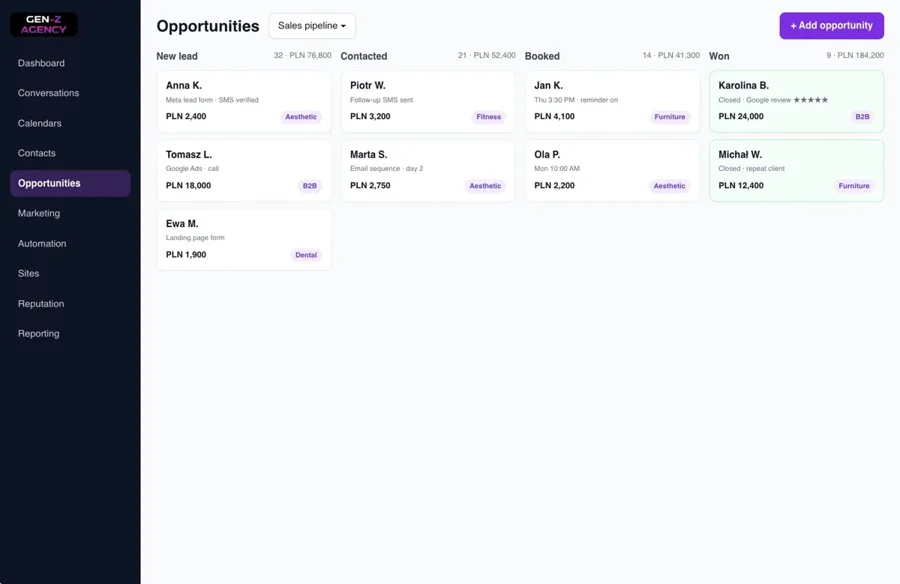
- Pipeline stages in your CRM that show how many leads got stuck along the way.
- Asking for a review after the service, because reviews help the next people decide.
The funnel at Gen Z Agency
We take care of the whole funnel, not just the ads. At the top are Meta Ads campaigns, Google Ads and UGC videos. The middle is a form or landing page with multiple-choice questions and SMS verification. The bottom is Gen Z CRM: the lead gets a text and an email within a second of signup, books a slot in the calendar, and gets a reminder before the appointment.
In the CRM you have your funnel stages and can see how many leads are at each one. For agency clients, the CRM costs $0. Book a free 30-min call and we will map out the funnel for your business.
Example: 1,000 clicks, 60 leads, 30 conversations, 10 sales. If you reach 45 leads by phone instead of 30, at the same close rate you gain 5 customers without raising your budget.
Frequently asked questions
01What is the difference between a sales funnel and a marketing funnel?
The terms are often used interchangeably. When they are separated, the marketing funnel ends at the lead, and the sales funnel also covers the conversation, the offer and the purchase.
02How many stages should a funnel have?
As many as the real steps your customer goes through. In a service business these are usually enough: lead, contacted, booked, sale. More stages make sense if someone keeps track of them.
03Does a small business need a funnel?
Every business has one, even if it never thinks about it. Mapping out your funnel shows where you lose customers: in the ad, on the page or when calling back.