




Are marketing agencies worth it? Run the break-even math first
Whether an agency is worth it is a math question first and a trust question second. Add the agency fee to your ad spend and divide by your gross profit per new customer. That gives you the number of extra customers the agency must bring in each month for you to break even.
Use gross profit, not revenue. A $2,000 job with $1,100 in labor and materials is worth $900 to you, and that $900 is what pays the agency. If customers come back, use 12-month gross profit. Judge a dental practice or a gym on the first visit and every channel will look worse than it is.
A worked example with hypothetical numbers for a US service business:
Bring the last line of that table to every agency call. If a proposal can't realistically deliver qualified leads below your maximum all-in cost, the agency isn't worth it at that price. A polished pitch deck doesn't change the math. Our campaign budget calculator and cost per lead calculator run the same numbers with your own figures.
Look at how much rides on the close rate. Move it from 1 in 5 to 2 in 5 and you need 18 qualified leads instead of 35. So if your team closes poorly, fix sales follow-up before you buy more traffic. If you don't know your close rate at all, count it for a month before you sign anything, because every other line in the table depends on it.
| Line | Example value |
|---|---|
| Agency fee per month | $2,500 |
| Ad spend per month | $3,000 |
| Total monthly cost | $5,500 |
| Gross profit per new customer | $900 |
| Customers needed to break even | 7 (5,500 ÷ 900 = 6.1, rounded up) |
| Close rate from qualified lead to sale | 1 in 5 |
| Qualified leads needed per month | 35 |
| Maximum all-in cost per qualified lead | $157 |
Agency vs in-house marketing: what each option really costs
The median annual wage for marketing managers in the US was $166,790 in May 2025, according to the US Bureau of Labor Statistics. That is about $13,900 a month. Payroll taxes, benefits and software come on top, and you still haven't spent a dollar on ads.
UK salaries are lower, but employment costs pile up. For 2025 to 2026, employers pay 15% Class 1 National Insurance on salary above £5,000 a year (GOV.UK). On a £45,000 marketing executive salary, that is £6,000 a year in employer NI alone. Pension contributions and tools are extra.
The salary isn't the real problem. Coverage is. One hire rarely handles ad buying, creative, video, landing pages, tracking and CRM setup. A good media buyer is usually not a good designer, and neither of them wants to configure Google Tag Manager. An agency gives you several specialists for less than one full salary. An in-house hire gives you depth and someone who thinks about your business all day.
Large companies rarely frame this as either/or. In the Gartner 2025 CMO Spend Survey of 402 marketing leaders, agencies took 20.7% of marketing budgets and in-house labor took 21.9%, with paid media the largest share at 30.6%. That split describes a hybrid. Strategy and knowledge of the business stay inside, while specialist execution goes outside.
Our view: if you have less than one full-time role's worth of marketing work, hiring in-house is the expensive option. Hire when one channel brings in most of your revenue and running it is a full-time job. Before that point, you are paying a full salary for part-time work.
| Option | What you pay | Who carries the risk | Best for |
|---|---|---|---|
| In-house marketer | Salary, payroll taxes, benefits and tools, fixed every month | You | Steady volume in one main channel, with enough work for a full-time role |
| Agency on retainer | Fixed monthly fee plus ad spend | Mostly you | Broad scope: brand, content, several channels |
| Agency charging a % of ad spend | A percentage on top of your spend | You, and the fee rises as spend rises | Large accounts with stable budgets |
| Pay-per-lead agency | Fixed price per qualified lead, with a monthly cap | Shared: the agency is paid only for leads | Service businesses that need calls, quotes or appointments |
| Freelancer | Hourly or per project | You | One clear task, such as a landing page or a campaign setup |
| Do it yourself | Your time | You | Very small budgets and early tests of an offer |
When a marketing agency is worth it
An agency earns its fee when it fills a gap you can't fill more cheaply or quickly yourself. The math usually works in these situations:
In each case you are buying speed and specialist skill. If you already have both in-house, you would be paying for something you own. The first situation is the strongest case of all: a sales process that already converts and is short only on leads is where an agency fee pays back fastest.
- You have a proven offer and a working sales process, but not enough leads.
- You need several skills at once (ads, creative, landing pages, tracking) and can't justify a hire for each.
- Your in-house results have stalled and nobody inside can explain why.
- You need to move fast: testing a new service, city or season without waiting months to hire.
- Marketing belongs to someone whose real job is something else, so it only happens in bursts.
When a marketing agency is not worth it
Agencies rarely write this part, because it costs them clients. In these situations we would tell you to keep your money for now:
An honest agency will turn some of these down. If one says yes to everything, treat that as a warning sign. Slow follow-up is the one we would fix first: it costs little to fix, and until you do, it wastes every lead you already pay for.
- Your offer hasn't sold yet. Ads amplify demand for something people already want. A weak offer or a price nobody accepts stays weak, it just gets more expensive.
- Nobody answers the leads. If inquiries sit in an inbox for a day, more leads just means more waste. Fix your response time first, or automate the first reply with a CRM that texts and emails every new lead.
- Your budget can't pay for a test. If the fee would eat most of your budget and leave too little ad spend to produce data, learn the basics yourself or pick an agency that charges per result.
- You can't measure anything. Without conversion tracking you will never know whether the agency works. Put GA4 and Google Tag Manager tracking in place first.
- You want guarantees the agency can't control. Sales depend on your team, your price and your follow-up as much as on the ads.
Pricing models decide who carries the risk
Two agencies with the same monthly price can be very different deals. The question is what you pay for: hours, a share of your ad spend, or results. For typical fee ranges, see our guide on how much a marketing agency costs.
Retainer. A fixed monthly fee for an agreed scope. It suits broad work like content, social media and brand, where output is hard to price per unit. The catch is simple: a bad month costs the same as a good one.
Percentage of ad spend. The fee grows with your budget, which can reward the agency for spending more rather than spending better. If your spend is rising, ask for a cap or a flat fee.
Pay per lead. A pay-per-lead model or a success fee moves the risk to the agency. You pay a fixed price for each qualified lead, usually with a monthly cap so costs can't run away. It fits service businesses that sell through calls, quotes or appointments. Brand awareness campaigns and online stores are a worse fit, since ROAS and revenue matter more there than lead counts. We compare the two main models in pay per lead vs retainer.
To compare offers fairly, convert every proposal into an expected cost per qualified lead with the same break-even table you built for your business. A cheap retainer that delivers nothing is the most expensive option on the list. We sell pay per lead, so weigh our opinion with that in mind. Still, for a business that lives on calls and quotes, we would not start with a retainer.
Are digital marketing agencies worth it for lead generation? Our numbers
We run lead generation on a pay-for-results model, so here is what it looks like in practice. One caveat first: our campaigns run in Poland, where Meta and Google ad auctions are cheaper than in the US or UK. You won't pay our cost per lead in Chicago or Manchester. The method and the trend carry over. For US and UK expectations, see what counts as a good cost per lead in 2026.
Since January 2026, our campaigns have generated 2,439 leads for clients, with 18 companies running campaigns with us in 2026. The average cost per lead across all clients was $6.97 (converted from PLN).
The trend says more than the absolute figure. For a hotel and corporate events client on Meta Ads, cost per lead fell from $9.92 to $3.31 between April and August 2026, about two-thirds lower, while monthly leads grew from 11 to 153. An aesthetic medicine clinic running Meta and Google Ads saw its blended cost per lead drop from $9.41 in June to $5.75 in August 2026, about 39% lower, with 139 leads in the CRM that month. That is why we would judge any agency over several months, never on the first one alone.
The setup behind those numbers:
Under this model you pay a fixed price per qualified lead with a monthly cap and no management retainer. Campaigns go live within 3 days. The details are on our pay-per-lead lead generation service page, and our portfolio shows real campaigns, landing pages and creatives.
- New ad creatives every week, so tired ads get replaced instead of running until results drop.
- Lead forms with SMS number verification and single-choice questions (3 to 4 answers) instead of free-text fields. This keeps fake numbers out.
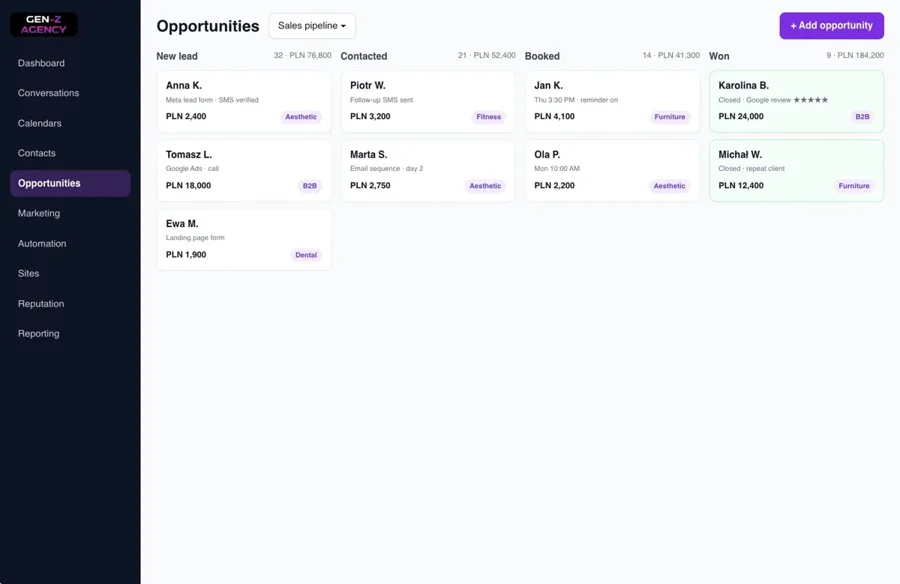
- An SMS and an email to every lead within 1 second of signing up, sent through Gen Z CRM, which agency clients get at $0.
- The whole ad budget goes to Meta and Google. We take no commission on ad spend.
Is your current agency worth the fee? A 30-day check
If you already pay an agency, you don't need to go on gut feeling. Ask for the following and give the agency a month to deliver:
Without the first two, nobody can measure performance yet, so fix tracking before you judge results. And if an agency resists giving you admin access to accounts you pay for, you already have your answer.
Give each channel a fair test window. Meta and Google lead campaigns produce usable data within weeks. SEO takes months. Judging SEO after 30 days is a mistake, and so is running paid ads for six months without a target.
- Admin access to your ad accounts, Meta pixel, GA4 property and Tag Manager container, all registered to your company.
- UTM parameters on every lead, and every lead landing in a CRM so you can trace it back to a campaign.
- Cost per qualified lead, not only cost per lead or cost per click.
- How many leads turned into sales last month. This needs both sides: the agency's lead data and your sales data.
- What was tested last month, what won, and what gets cut next.
- A plan for the next 30 days with a target cost per qualified lead.
Red flags to check before you sign
Many bad agency experiences trace back to the contract, not the campaigns. Check these points before you sign:
Our view: the safest first engagement is short, judged on cost per qualified lead, and starts with your company owning every account. To see whether pay per lead fits your numbers, book a free 30-min strategy call and bring your break-even figure.
- The agency opens ad accounts in its own name. If you leave, you lose the account history and the pixel data. The safe setup is the reverse: Google's own documentation describes how an agency manages client accounts from a Google Ads manager account, linked to an ad account you own. If you part ways, you remove the link and keep the account.
- A long minimum term with no exit clause tied to performance.
- An undisclosed markup or commission on ad spend.
- Reports built on impressions, reach and clicks, with nothing on leads, qualified leads or sales.
- Guaranteed Google rankings or guaranteed revenue.
- Nobody can tell you who works on your account or what changed last week.
Frequently asked questions
01Is it worth paying a marketing agency for a small business?
Yes, when the agency's total cost (fee plus ad spend) is lower than the gross profit from the extra customers it brings in. The small businesses that gain most have a proven offer and someone who follows up on leads. If your offer hasn't sold yet or you can't measure results, put the money into fixing that first.
02Is it cheaper to hire an agency or an in-house marketer?
For most small businesses, an agency is cheaper. The US Bureau of Labor Statistics puts the median annual wage for marketing managers at $166,790 (May 2025), before payroll taxes and benefits. In-house wins once one channel has enough work to keep a full-time person busy. Plenty of companies use both, with strategy inside and specialist execution outside.
03How much should I pay a marketing agency?
Start from your break-even point, not the agency's price list. Divide your total monthly cost by your gross profit per customer to get the customers you need, then turn that into a maximum cost per qualified lead. Fees vary widely by scope and pricing model, and our guide on marketing agency costs breaks down the common structures.
04How long does it take to see results from a marketing agency?
Paid campaigns on Meta and Google produce lead data within the first few weeks, and our campaigns go live within 3 days. After that, cost per lead should come down as creatives and targeting get tested. SEO takes months, so give it a longer window.
05What should a marketing agency report each month?
At minimum: spend, leads, qualified leads, cost per qualified lead and, matched against your sales data, how many leads became customers. The report should also say what was tested and what changes next month. Impressions and clicks alone can't tell you whether the agency is worth it.
06Should I own my ad accounts when working with an agency?
Yes. Your Meta Business account, ad accounts, pixel, GA4 property and Tag Manager container should be registered to your company, with the agency added as a partner. If the agency owns them, your data and account history leave with it.
Was this guide helpful?One click helps us write better ones.
Thanks! The next guide is waiting below.
Thanks for being honest. Ask us directly: book a free 30-min call.