




12 dental marketing ideas ranked by speed and cost
Most lists of dental marketing ideas give a billboard and a Google Ads campaign equal weight. They don't deserve it. We rated each idea by how fast it usually produces booked patients and what it costs to run, the same way we plan lead generation campaigns for service businesses.
Our rule for practices is simple: run one fast channel and one compounding channel at the same time. Paid ads fill the chair this quarter. The slow channels, reviews and SEO above all, lower your cost per patient next year. Pick only one and you either pay for ads forever or spend six months waiting on SEO.
If we had to start with a single row, it would be number 4. It costs little, and it makes every other channel on the list convert better.
| Idea | Best for | Speed to first patients | Cost | Our verdict |
|---|---|---|---|---|
| 1. Google search ads on treatment and emergency keywords | Emergencies, implants, aligners | Days | Medium to high | Start here if the budget allows |
| 2. Facebook and Instagram lead ads with a new-patient offer | Whitening, aligners, implant consultations | Days | Medium | Best channel for elective care |
| 3. One landing page per treatment | Every paid campaign | 1 to 2 weeks to build | Low | Required before you scale ads |
| 4. Instant SMS and email reply to every lead | Every lead source | Immediate | Low | Highest return per dollar on this list |
| 5. Online booking calendar | Exams and consultations | Immediate | Low | Cuts phone tag |
| 6. Remarketing to site visitors | Practices with steady traffic | Weeks | Low | Add after month one |
| 7. Google Business Profile cleanup | Every practice | 1 to 3 months | Time only | Do it this week |
| 8. Automated review requests after visits | Every practice | Weeks to months | Low | Set up once, runs forever |
| 9. Local SEO pages for each treatment | Competitive cities | 3 to 6 months | Medium | Long-term play |
| 10. Recall and reactivation campaigns | Practices with a patient list | Days | Very low | Cheapest bookings you will get |
| 11. Patient referral program | Family and general dentistry | Months | Low | Check local rules first |
| 12. Short dentist-on-camera videos (9:16) | Social and ads | Weeks | Low to medium | Feeds both ads and trust |
Google Ads for dentists: reach patients who are already searching
Google search ads show your practice to someone typing "emergency dentist near me" or "dental implants cost" right now. That intent is why search is our first pick for urgent care and high-value treatments. Nobody needs convincing that they want a dentist. They need a reason to pick you.
According to LocaliQ's 2026 search advertising benchmarks, dentists and dental services pay a median of $8.00 per click and $72.97 per lead, with 10.67% of clicks turning into leads. The all-industry figure is $66.69 per lead. So dental clicks cost more, but they also convert better than average. The person searching usually has a real problem or has already decided on a treatment.
We build dental accounts around five decisions:
Under about $1,500 a month, we would not split search across four treatments. At $8.00 per click, $1,500 buys roughly 187 clicks and, at the benchmark conversion rate, about 20 leads. That is enough to learn from in one campaign and far too thin across four. Pick the treatment with the highest value and spare chair time, and run it alone. Our Google Ads campaigns for service businesses follow the same logic, and our guide to how much Google Ads costs in 2026 breaks down the budget side.
- One campaign per treatment line (emergency, implants, aligners, new-patient exams), so cheap checkup searches don't eat the implant budget.
- Phrase and exact match on treatment plus location terms, with negative keywords for jobs, salary, school, DIY and "free".
- Call assets during office hours, with calls tracked as conversions. Emergency patients call. They rarely fill in forms.
- A dedicated landing page per treatment, never the homepage. Put the price range, financing, reviews and a booking button above the fold.
- Conversion tracking in GA4 for forms, calls and bookings, so Google's bidding learns which clicks turn into patients. If this is missing, fix it before anything else with GA4 and Tag Manager setup.
Dental Facebook ads: create demand for elective treatments
Facebook and Instagram don't catch people mid-search. They reach people near your practice who might want straighter or whiter teeth but haven't started looking. That makes Meta the stronger channel for elective treatments and the weaker one for emergencies. We would not put Meta budget behind emergency dentistry at all.
Meta is not cheap for dentists. LocaliQ's 2026 Facebook advertising benchmarks show dental lead campaigns at a 1.62% click-through rate, $5.70 per click, a 6.07% conversion rate and $61.56 per lead. Across all industries the average is $27.39 per lead, so dentistry costs more than twice as much. More budget rarely fixes that. A sharper offer and faster follow-up usually do.
Our lead form setup for Meta Ads campaigns has two rules. SMS number verification comes first, so fake numbers and accidental taps never reach your front desk. Then single-choice questions with 3 to 4 answer options instead of free-text fields: which treatment, when they want to start, the best time to call. Each answer hands the front desk an opening line for the first call. You can see the pattern in our Facebook lead ads examples.
Creative matters more on Meta than on Google. We shoot vertical 9:16 video for Reels and Stories, write 3 hook versions for every idea and ship new creatives every week. The same ad shown to the same local audience wears out fast. A dentist filmed on a phone, explaining what an aligner consultation involves, often beats polished studio footage, because it shows the person the patient will actually meet. Our UGC video team makes exactly this kind of content.
The closest industry we have run is aesthetic medicine, which sells elective, consultation-based treatment much like cosmetic dentistry. For an aesthetic medicine clinic in Poland running Meta and Google Ads, the CRM logged 139 leads in August 2026. Of those, 91 came from the Meta lead form. The blended cost per lead was $5.75 (converted from PLN), down from $9.41 in June. Polish auctions are far cheaper than US or UK ones, so don't treat $5.75 as a price to expect. The useful number is the drop: about 39% in two months. More on that industry in our med spa marketing guide.
| 2026 dental benchmark (US) | Google search ads | Facebook lead ads |
|---|---|---|
| Click-through rate | 5.66% | 1.62% |
| Cost per click | $8.00 | $5.70 |
| Conversion rate | 10.67% | 6.07% |
| Cost per lead | $72.97 | $61.56 |
| Best use | Emergencies, implants, people comparing practices | Whitening, aligners, new-patient offers |
How to get more dental patients from the leads you already pay for
The cheapest new patient is the one whose lead you already paid for. Someone who waits until tomorrow for a callback has often booked elsewhere or forgotten your ad by then. Before you touch the budget, check what happens in the first hour after a form comes in.
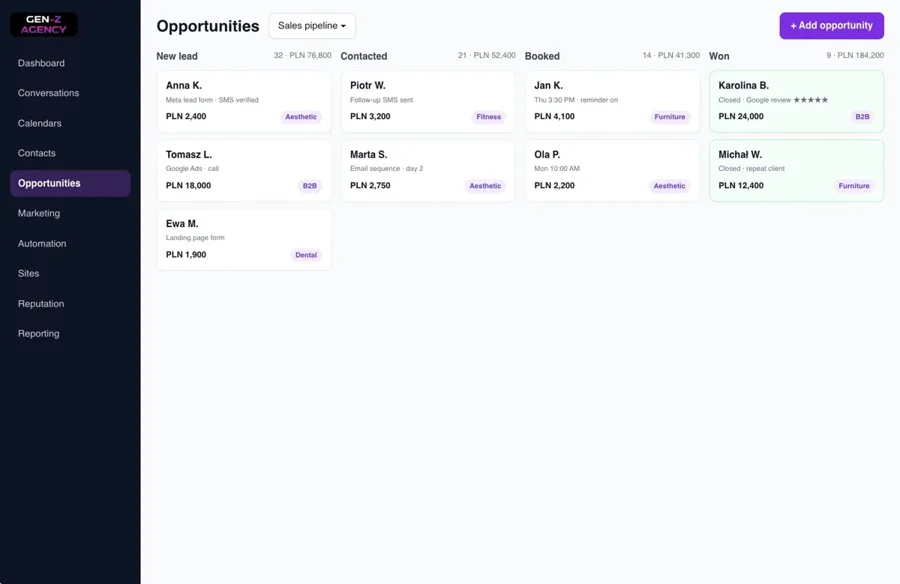
In our setup, Gen Z CRM sends every lead an SMS and an email within 1 second of signing up. Agency clients get the CRM at $0. The message thanks them, confirms the treatment they picked and links to a booking calendar. Motivated patients can book themselves before anyone at the front desk picks up the phone.
Doubling ad spend on a leaky process doubles the waste. If the front desk can't call ad leads the same day, automate the first touch with SMS and email automation and make the call step two. Of everything in this guide, this is the fix we would make first, even ahead of a new campaign.
- Instant reply: SMS and email within the first minute, with a booking link.
- Same-day call: make ad leads the front desk's first priority, ahead of routine callbacks.
- Self-booking: an online calendar for new-patient exams and consultations.
- Reminders: SMS the day before the visit, with an easy way to reschedule instead of a silent no-show.
- Follow-up sequence: for leads who don't book, a short series of emails (we typically use 3 after sign-up) that deals with the usual worries about price and pain.
- Source tracking: record lead, booked, showed and treatment accepted for each channel, so you compare cost per patient, not cost per lead.
Low-cost dental marketing strategies that compound over time
Paid ads stop the day you stop paying. These keep working. They also make your ads cheaper, because people who see an ad check your reviews and your Google listing before they book.
Google Business Profile. Pick the right primary category, list every service you offer, upload real photos of the team and treatment rooms, keep holiday hours current and add a booking link. It costs you an afternoon. Our local SEO guide for small businesses covers the full checklist.
Review requests. Ask every patient by SMS the same day, while the visit is fresh. Reply to every review, the bad ones especially. In the US, stay inside the FTC rule on fake reviews and testimonials, in effect since October 21, 2024. It bans fake or bought reviews and rewards tied to positive reviews, and reviews by staff must disclose the connection. If you can set up only one of these strategies, make it automated review requests.
Recall and reactivation. Your existing patient list is the cheapest audience you have. An SMS and email campaign to patients overdue for a hygiene visit costs almost nothing and books chairs within days. If the list has never been contacted, we would run this before spending a single dollar on cold ads.
Referrals. Referral programs suit family practices, but the rules vary. Some US state dental boards restrict paying for patient referrals, and UK practices fall under GDC guidance. Until you have checked, stick to a handwritten thank-you or a donation to a local charity.
Treatment pages that answer real questions. Patients search for prices and for whether a treatment hurts. A page per treatment that answers both plainly ranks over time and doubles as your ad landing page. Put a price range or a "from" price near the top. Hide it, and the question just moves to your phone line. If you don't have these pages, our team builds landing pages for paid campaigns.
Dental ad rules in the US and UK: what you can and can't say
Healthcare ads get rejected more often than most, and a rejected ad stalls a campaign for days. Write compliant copy from the start. We are not lawyers, so have your indemnity provider or compliance adviser check your first ads. These are the rules we plan around.
Meta, all countries. Meta's advertising standards on personal attributes ban copy that asserts or implies the viewer has a health condition. "Embarrassed by your crooked teeth?" breaks the rule. "Aligner consultations in Leeds, free scan this month" does not. Our quick test: if the headline is about the viewer's teeth, rewrite it around the treatment and the offer.
United States. Besides the FTC reviews rule, HIPAA requires a patient's written authorization before you use their photos or testimonial in marketing. State dental boards also regulate claims such as "specialist". Keep a signed consent form on file for every before-and-after image. We would show those images on the landing page rather than in the ad itself.
United Kingdom. The General Dental Council's guidance on advertising requires your GDC registration number on promotional material and a clear statement of whether the practice is NHS, mixed or private. The word "specialist" is reserved for dentists on a GDC specialist list. Ads also fall under the ASA and CAP advertising codes.
- Do: name the treatment, the location and a concrete offer.
- Do: keep written consent for every patient image and testimonial.
- Do: show price ranges or "from" prices you can actually honor.
- Don't: imply the viewer has a dental problem in Meta ad copy.
- Don't: buy reviews, gate reviews or reward only 5-star feedback.
- Don't: call anyone a specialist unless they hold that registration.
Budget math: what a new dental patient costs, and when ads are not worth it
Agencies report cost per lead. Cost per patient seen is the number that pays your rent. The example uses the 2026 Google benchmark, while the booking and show rates are assumptions. Swap in your own front-desk numbers.
On these assumptions, a new patient in the chair costs about $188. Whether that is good depends on what a new patient is worth to your practice over the first year. If most leads accept treatment plans worth several times that, the channel pays. If most want a free cleaning and never come back, it doesn't. Run your own numbers in our campaign budget calculator and compare them with our guide to what a good cost per lead is in 2026.
Hold off on paid ads if any of these apply to you:
- No chair time. If new patients would wait four weeks or more for an exam, many will book elsewhere. Fix capacity first.
- Nobody answers leads the same day. Set up automated replies and a booking calendar before you buy traffic.
- A thin review profile. People who click your ad will check Google. A handful of old reviews loses them to the practice next door.
- A budget too small to learn from. $500 a month on Google at $8.00 per click buys about 62 clicks and 6 or 7 leads. You can't judge a channel on that. At that budget we would skip Google Ads for now and put the money into recall and reviews.
| Step | Value | Source |
|---|---|---|
| Monthly Google Ads budget | $3,000 | Example |
| Cost per lead | $72.97 | LocaliQ 2026 dental median |
| Leads per month | 41 | $3,000 / $72.97 |
| Leads who book (assumed 50%) | 20 | Your front desk data |
| Booked patients who show (assumed 80%) | 16 | Your front desk data |
| Cost per new patient seen | about $188 | $3,000 / 16 |
A 90-day dental marketing plan, and how we run it
This is the order we would follow for a practice starting from scratch. Tracking and follow-up come first, because a campaign without them produces numbers you can't trust. The step we would never skip is call tracking. Emergency patients phone instead of filling in forms, and without call data Google learns from the wrong people.
If you want us to run it, campaigns go live in 3 days and new creatives ship every week. For lead generation you pay a fixed price per qualified lead with a monthly cap, and there is no management retainer. The whole ad budget goes to Meta and Google, and we take no commission on ad spend. Gen Z CRM, which sends the instant SMS and email replies, is included at $0.
Since January 2026 we have delivered 2,439 leads for 18 companies at an average cost per lead of $6.97 (converted from PLN). Those campaigns ran in Poland, where auctions are much cheaper, so set expectations for your own market with the LocaliQ benchmarks instead. What carries over is the method, especially verified lead forms and instant follow-up. Book a free 30-min strategy call and we will map this plan to your treatments and budget.
- Week 1: clean up your Google Business Profile, set up GA4 and call tracking, and build one landing page per priority treatment.
- Week 1 to 2: launch Google search for one or two treatments and one Meta lead campaign for a single elective offer.
- Week 2: switch on instant SMS and email replies, online booking and automated review requests.
- Weeks 3 to 6: refresh creatives weekly, add negative keywords, and pause ad sets whose cost per booked patient is above target.
- Weeks 6 to 8: add remarketing to site visitors and run a recall campaign to your existing patient list.
- Weeks 9 to 12: compare cost per patient seen by channel and move budget to the winner.
Frequently asked questions
01What is the best marketing for a dental practice?
For fast results, run Google search ads on treatment and emergency keywords, backed by instant follow-up and online booking. Facebook and Instagram lead ads usually do better for elective treatments such as whitening and aligners. Over time, a strong Google Business Profile, steady reviews and recall campaigns bring the cost per patient down.
02How much does a dental lead cost?
LocaliQ's 2026 US benchmarks put the median dental lead at $72.97 on Google search and $61.56 on Facebook lead campaigns. Your own cost will swing with the city, the treatment and the offer. Judge campaigns by cost per patient seen, not by cost per lead alone.
03Do Facebook ads work for dentists?
Yes, mainly for elective treatments people are not actively searching for yet, such as whitening, aligners and implant consultations. For emergencies they work poorly, and Google search is the better choice. Use verified lead forms, call leads the same day, and avoid ad copy that implies the viewer has a dental problem.
04How can I get more dental patients quickly?
Start with a recall campaign to your existing patients, which can book chairs within days at almost no cost. At the same time, launch Google search ads for your highest-value treatment and make sure every lead gets an instant reply and a booking link. Paid campaigns can go live within days once tracking and a landing page are ready.
05How much should a dental practice spend on ads each month?
Work backward from cost per lead. At the 2026 Google benchmark of $72.97 per lead, $1,500 a month buys roughly 20 leads, which is enough to test one treatment. Below about $500 a month there is too little data to judge results, so put that money into recall and reviews first.
06Can dentists use patient reviews and before-and-after photos in ads?
Yes, with written patient consent. In the US, a patient's photos or testimonials used in marketing need HIPAA authorization. Never buy reviews or reward only positive ones, which the FTC rule prohibits. Platforms check health imagery closely, so many practices keep before-and-after photos on the landing page rather than in the ad.
Was this guide helpful?One click helps us write better ones.
Thanks! The next guide is waiting below.
Thanks for being honest. Ask us directly: book a free 30-min call.