




What is the best lead generation for contractors?
No single channel wins. What works is a stack: Google catches people who are already searching, Meta creates demand before they search, and your Google Business Profile, reviews and referrals keep growing in the background for free. The right order depends on your trade, and on how fast someone in your office answers the phone.
Start where intent is highest and where you can measure results within 30 days. For most US contractors, that means Google Search plus Local Services Ads. Meta comes second. It earns its place on planned jobs like a roof replacement, a new HVAC system or a remodel, where homeowners research for weeks before they call.
The click costs in the table are US medians from LocaliQ's 2025 search ad data. We don't quote a single figure for Meta or marketplaces, because their costs swing too much by market to give one honest number.
| Channel | Lead type | How you pay | Best for | Our take |
|---|---|---|---|---|
| Google Search ads | Exclusive | Per click (US home services median CPC $7.85) | Emergency repairs, “near me” searches | Start here: highest intent, fully measurable |
| Google Local Services Ads | Exclusive | Per lead (calls, messages, bookings) | Phone-heavy trades: HVAC, plumbing, roofing | Run it alongside Search, not instead of it |
| Meta lead forms (Facebook, Instagram) | Exclusive | Per impression | Replacements, installs, seasonal offers | Cheaper leads with lower intent, so qualify hard |
| Google Business Profile and local SEO | Exclusive | Free, costs time | Every contractor | Essential base, slow to build |
| Marketplaces (Angi, Thumbtack, HomeAdvisor; Checkatrade, MyBuilder, Rated People in the UK) | Often shared | Per lead, membership or both | New firms, quiet weeks | Fine as a supplement, risky as your foundation |
| Referrals and repeat customers | Exclusive | Free or a referral reward | Established firms | Usually your warmest leads, but you can't scale them on demand |
How much do contractor leads cost in 2026?
The most useful public numbers for paid search by trade come from LocaliQ's 2025 search ad benchmarks for home services, based on US campaigns that ran from April 2024 to March 2025. LocaliQ reports medians, so a few extreme accounts can't skew the figures.
Two things stand out. Roofing has the most expensive clicks and the highest cost per lead, which makes your landing page and form matter more there than in almost any other trade. General contractors pay the least per click ($5.31) but convert only 2.61% of clicks. Broad searches like “contractor near me” pull in a lot of window shoppers, so a general contractor is better off bidding on specific project searches before generic ones.
There is no equally detailed public benchmark by trade for the UK. For UK contractors, we would plan a 30-day test budget and set targets from your own first month of data. US figures won't transfer cleanly.
Our own numbers come from Poland, where ad auctions are far cheaper. Across all clients from April to September 2026, our average Google Ads CPC was $0.24 (converted from PLN). The US roofing median is $10.70. Treat our figures as evidence for the method, never as a price forecast for the US or UK. For a wider view by industry, see what a good cost per lead looks like in 2026.
| Trade (US, Google Search) | CTR | Avg. CPC | Conversion rate | Cost per lead |
|---|---|---|---|---|
| HVAC | 6.43% | $9.68 | 6.56% | $127.74 |
| Roofing and gutters | 5.66% | $10.70 | 3.70% | $228.15 |
| General contractors | 6.48% | $5.31 | 2.61% | $165.67 |
| Plumbing | 4.97% | $10.49 | 7.63% | $129.02 |
| Home services average | 6.37% | $7.85 | 7.33% | $90.92 |
Cost per lead is the wrong finish line: work out cost per booked job
A $60 lead who never picks up the phone costs you more than a $200 lead who books an inspection. Track three numbers: cost per lead, the share of leads that book an appointment, and the share of appointments that become jobs. Multiply the two rates, divide cost per lead by the result, and you have cost per won job. Put that next to your gross profit per job.
The table uses LocaliQ's medians with assumed conversion rates. Those rates are illustrations only. Swap in your own numbers from the last 90 days.
Now look at the lever most contractors ignore. In the roofing row, lifting the booking rate from 50% to 65% with faster callbacks and better qualifying cuts cost per won job from $1,521 to $1,170. Ad spend doesn't change. For most contractors, that is an easier win than squeezing cost per lead.
To run the numbers for your own business, use our CPL calculator, then the campaign budget calculator to see how much spend a target number of jobs needs.
| Trade | US median CPL | Leads that book (assumed) | Appointments that close (assumed) | Cost per won job |
|---|---|---|---|---|
| Roofing | $228.15 | 50% | 30% | $1,521 |
| HVAC | $127.74 | 60% | 50% | $426 |
| General contractor | $165.67 | 40% | 25% | $1,657 |
| Plumbing | $129.02 | 60% | 60% | $358 |
Roofing leads: what works and what to avoid
Roofing has two very different buyers. Repair and leak calls are urgent, and those people go straight to Google. A full replacement is a big planned purchase, often tied to an insurance claim or a home sale. Those buyers research for weeks.
For repairs, put the budget into Google Search and Local Services Ads first, with call assets and tight local targeting. Only 3.70% of roofing search clicks convert in LocaliQ's data, about half the home services average of 7.33%. Your homepage won't fix that. Send clicks to a dedicated landing page with one form and a click-to-call button.
For replacements, Meta lead forms work when the form does the filtering. Use 3 or 4 single-choice questions, not open text fields. Each answer tells your estimator something before the first call:
Skip storm-chaser lists and shared leads after big weather events. Every roofer in the area buys the same names on the same day, and the homeowner's phone keeps ringing for an hour. Run your own campaign in your zip codes or postcodes instead, so the names are yours alone and you reach them while demand is spiking. Better still, build that campaign before storm season and keep it paused, so turning it on takes minutes. Starting from zero, we get new campaigns live in 3 days.
For creatives, use before-and-after photos and short 9:16 videos of your crew on a real roof. Stock images make you look like every other roofer. The homeowner is deciding whether to trust a crew they have never met, and real footage answers that better than polish. Our Meta Ads campaigns pair each idea with several hook versions so the weak ones get cut fast.
- Do you own the property? (Yes / No)
- What do you need? (Repair / Full replacement / Inspection / Help with an insurance claim)
- How old is the roof? (Under 10 years / 10 to 20 years / Over 20 years / Not sure)
- When do you want the work done? (As soon as possible / In 1 to 3 months / Just researching)
HVAC leads: separate emergency calls from planned installs
HVAC lead generation breaks down when one campaign tries to sell a broken AC repair in July and a heat pump install in April. Those buyers want different things on different timelines. Give each one its own campaign and its own budget.
Local Services Ads deserve a closer look in HVAC, because the billing rules hit phone-heavy trades hardest. According to Google's help page on how leads work, you pay for answered calls. During business hours you also pay for missed calls if the caller stays on the line for more than 20 seconds. Repeat contacts from the same number or email within 15 days aren't charged again, and message leads usually cost less than phone leads. So a missed call isn't free. You paid for that lead and handed it to a competitor, which is why we would hold off on Local Services Ads until someone can reliably pick up during the day.
UK contractors should note one more line on the same Google page: lead credits aren't available to advertisers in EMEA. Don't count on automatic refunds for bad leads. Check lead quality every week and tighten your service areas and job types instead.
If you'd rather hand this off, our Google Ads team builds separate search campaigns for repair, replacement and maintenance terms, each tracked through to the booked call.
- Emergency repair (no heat, no cooling): Google Search and Local Services Ads with call-focused ads. Weight the budget toward the hours your techs can actually respond.
- System replacement and heat pumps: high-intent search terms plus Meta lead forms that ask about system age, property type and timeline. Financing and rebate messages belong here.
- Maintenance plans and tune-ups: Meta ads and email to past customers before peak season. This is how you fill the quieter shoulder months.
Shared vs exclusive leads: are Angi, Thumbtack and Checkatrade worth it?
Marketplaces sell access to homeowners who asked for quotes. In the US that means Angi, HomeAdvisor and Thumbtack. In the UK it's Checkatrade, MyBuilder and Rated People. Pricing (per lead, membership or both) varies, and much of it isn't published, so get a written quote for your trade and area before you commit.
The core problem is that many marketplace leads are shared. One homeowner fills in one form and hears from several contractors, and the job often goes to whoever calls first or quotes lowest. You're also building the platform's brand instead of your own. Stop paying and the leads stop, with nothing left behind.
Marketplaces make sense in a few situations:
Drop a platform once its cost per won job is higher than on Google or Meta, or when the only way you win there is on price. Exclusive leads look more expensive per lead on paper. But you're the only company that homeowner contacted. To compare buying models in detail, read our guide to pay per lead marketing.
- You are new, have few reviews and need jobs this month.
- Your crews have spare capacity in a slow season and you can call back within minutes.
- You want to test demand in a new service area before paying for your own ads.
- You track cost per won job for each platform separately, so you know when one stops paying for itself.
The lead generation system we build for service businesses
Ads are only the first step. Most of what decides your cost per job happens between the form and the first conversation, so we build the whole path, from the ad to the booked estimate. This is the setup behind our pay-per-lead lead generation service for service businesses:
Results so far in 2026: 2,439 leads for 18 companies since January, at an average cost per lead of $6.97 (converted from PLN). At an aesthetic medicine clinic, blended cost per lead fell from $9.41 in June to $5.75 in August, about 39% lower, with 139 leads in the CRM in one month. A hotel and corporate events client went from $9.92 to $3.31 per lead between April and August 2026.
The limits matter here. These campaigns ran in Poland, in hospitality, healthcare, training and car sales. None of them were roofing or HVAC, and Polish ad auctions are much cheaper than US or UK ones. What carries over to contractors is the method and the size of the relative improvement. The dollar figures don't.
- Qualifying form: lead forms with 3 to 4 single-choice questions instead of free-text fields. The homeowner taps answers in seconds, and you see job type, timeline and ownership before you call.
- SMS number verification: the homeowner confirms their phone number with a code before the lead counts, which removes fake and mistyped numbers. See how it works in our contact forms with SMS verification.
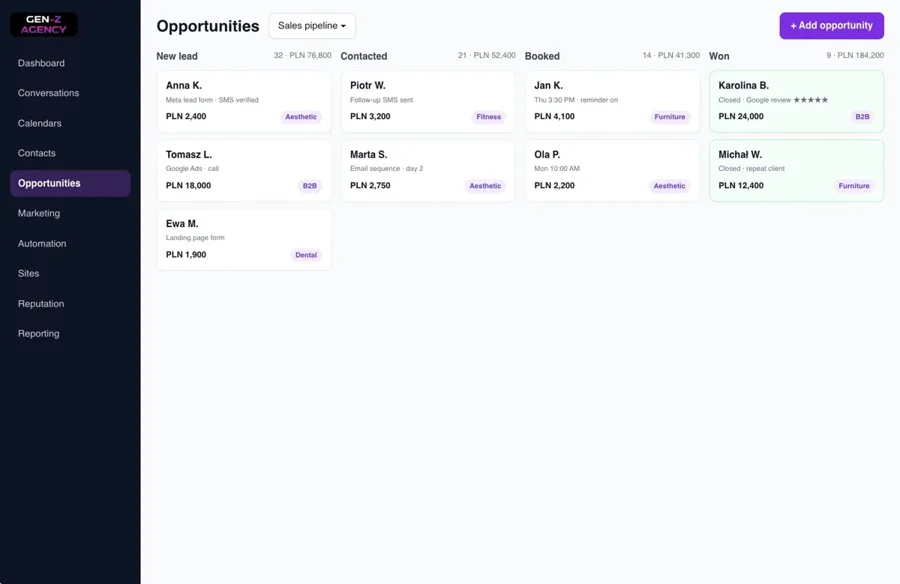
- Reply within 1 second: every lead gets an SMS and an email within 1 second of signing up, sent from the Gen Z CRM app, which our agency clients get for $0.
- Self-booking: a booking calendar link lets the homeowner pick an estimate slot right away instead of waiting for a callback.
- Pipeline and follow-up: every lead lands in a CRM pipeline, with automated reminders and a short email sequence (typically 3 emails after sign-up) for people who aren't ready yet. This runs on marketing automation.
- New creatives every week: fresh ad creatives weekly, plus 9:16 UGC videos from our team of 8 creators, with 3 hook versions for every idea. Ads that never change go stale.
- Tracking to the booked job: conversion tracking and UTM tags show which ad produced which booked estimate.
Mistakes that waste contractor ad budgets, and when lead gen is not worth it
Fix these before you spend another dollar on ads:
Sometimes the honest answer is not to buy leads at all. Paid lead generation isn't worth it if you're booked out for two months or more. The same goes if nobody can answer the phone or return calls within the hour, or if your margin per job can't absorb a realistic cost per won job for your trade. Fix capacity or raise prices first. Often the best first hire is someone for the office, not more ad spend.
A thin review profile is another reason to wait a few weeks. Every paid lead checks your reviews before calling, and a profile with a handful of them makes each click work harder than it should. Ask past customers for reviews and work through our Google Business Profile optimization guide before you pay for clicks.
- Sending ad traffic to a homepage with five menus instead of a landing page with one form.
- Using open text fields like “describe your project”. They slow people down and give you nothing to filter on.
- Calling back the next morning, when the homeowner may already have booked someone else.
- Judging channels by cost per lead alone. Cheap Meta leads that never book can cost more per job than Google leads at three times the price.
- Running one campaign for every service, so your emergency repair budget gets spent on people researching a remodel.
- No tracking past the form, so nobody knows which ads produce booked jobs.
Pay per lead, retainer or DIY: how to buy contractor leads
You have three ways to run this. DIY works if you have a few hours a week and the patience to learn Google Ads and Meta. Start with a small search budget and a complete Google Business Profile. A retainer agency charges a monthly management fee whatever the results. Pay per lead ties the fee to qualified leads delivered.
We work on the third model. You pay a fixed price per qualified lead with a monthly cap and no management retainer. Your whole ad budget goes to Meta and Google, and we take no commission on ad spend. Campaigns go live in 3 days. For a side-by-side comparison, read pay per lead vs retainer.
Whichever route you choose, ask any provider three things before you sign. Are the leads exclusive to you? What counts as a qualified lead, and can you reject bad ones? Who owns the ad accounts and the data if you part ways? A vague answer to that last one is a warning sign.
If you want a second opinion on your current setup, book a free 30-minute strategy call. We'll work out your cost per booked job and show you where leads are leaking between the ad and the estimate.
Frequently asked questions
01How much do contractor leads cost?
In LocaliQ's 2025 US search benchmarks, the median cost per lead is $90.92 across home services, $127.74 for HVAC, $129.02 for plumbing, $165.67 for general contractors and $228.15 for roofing. Marketplace and Meta lead prices vary too much by market for one honest figure. Compare channels by cost per won job, because a cheap lead that never books ends up being the expensive one.
02What is the best lead generation for contractors?
For most established contractors, the best setup combines Google Search and Local Services Ads for urgent jobs, Meta lead forms with qualifying questions for planned projects, and a well-maintained Google Business Profile. Add instant SMS and email follow-up so no lead sits waiting. Marketplaces work as a supplement, not a foundation.
03Are Angi, Thumbtack or Checkatrade leads worth it?
They can be, for new businesses with few reviews or for filling quiet weeks when you can call back within minutes. Many marketplace leads are shared with other contractors, so the job often goes to whoever responds first or quotes lowest. Track cost per won job on each platform and drop any that cost more than your own ads.
04How do HVAC companies get more leads?
Split campaigns by urgency: Google Search and Local Services Ads for emergency repairs, search plus Meta lead forms for system replacements, and Meta plus email to past customers for maintenance plans before peak season. Answer every call. Google can charge for missed Local Services Ads calls during business hours when the caller stays on the line for more than 20 seconds.
05How do roofers get leads without buying shared storm leads?
Run your own Google Search and Local Services Ads for repair searches, and switch on Meta lead forms in your zip codes or postcodes after a storm. Single-choice questions on ownership, roof age and timeline filter out weak leads. Unlike lists sold to every roofer in the area, these leads are yours alone.
06Should contractors pay per lead or hire an agency on retainer?
Pay per lead ties your cost to qualified leads delivered, while a retainer charges a fixed fee whatever the results. Pay per lead suits contractors who want predictable acquisition costs and don't want to manage campaigns themselves. Either way, confirm that leads are exclusive, that you can reject bad ones and that you own the ad accounts.
Was this guide helpful?One click helps us write better ones.
Thanks! The next guide is waiting below.
Thanks for being honest. Ask us directly: book a free 30-min call.